Power of attorney requirements by state in UAE is an important legal tool that allows a person (the principal) to authorize another person (the attorney) to perform legal or administrative acts on their behalf. By 2026, the process will be fully digital and seamless. The POA&More team provides a comprehensive guide to power of attorney requirements by state in UAE.
Power of Attorney Requirements in the UAE
To legally fulfill the requirements for Power of attorney requirements by state in UAE, the following criteria must be met:
- Legal Capacity: Both the principal and the attorney must be at least 21 years old (in civil matters) and of sound mind.
- Identity: Residents must possess a valid Emirates ID card, or a valid passport for parties from outside the country.
- Ownership: The principal must own the right they are delegating (e.g., a person cannot be appointed to sell a property that the principal does not actually own).
What are the power of attorney requirements by state in UAE?
Power of attorney requirements in the UAE vary slightly depending on the emirate (e.g., Dubai and Abu Dhabi) and the type of power of attorney (general or special), but there is a unified legal framework regulated by the Ministry of Justice and local judicial departments. The following outlines the power of attorney requirements by state in the UAE:
- Legal Capacity: The principal must be at least 21 years old (for civil transactions) or 18 years old (for commercial transactions).
- Language: The power of attorney must be written in Arabic or bilingually (Arabic-English). If issued outside the country, it must be translated by a certified legal translator.
- Identity: The principal must be present and present their original Emirates ID (for residents) or original passport (for visitors).
- Notarization: A power of attorney is not recognized unless it is notarized by a notary public (either a court-appointed public or a licensed special notary).
Why might foreign residents need a power of attorney in the UAE?
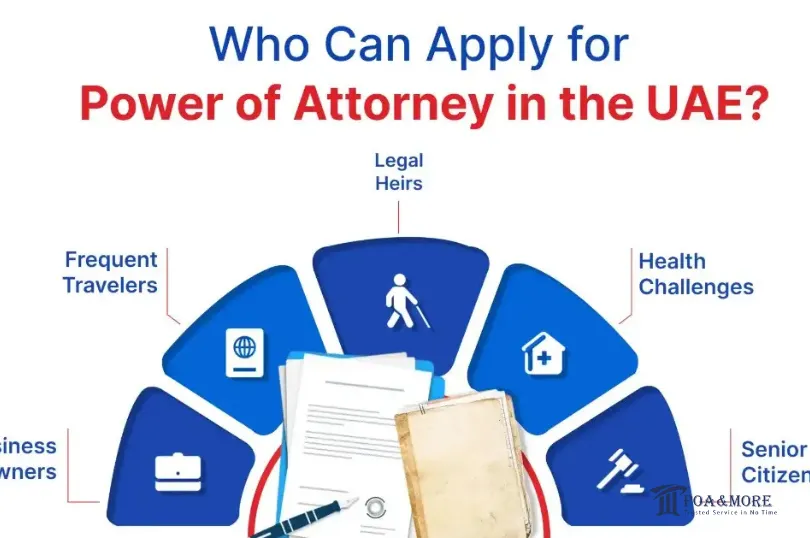
A Power of Attorney (POA) is a crucial legal tool for foreign residents in the UAE, given the nature of their lives, which may require travel or managing obligations in more than one country. Here are the main reasons why a resident might need a power of attorney:
1. Property and Vehicle Management
- Buying and Selling: If you wish to buy or sell a property (land, apartment, villa) and cannot be physically present to sign at the Land Department.
- Leasing and Management: Authorizing an attorney to collect rent, renew contracts, or maintain the property while you are traveling.
- Vehicles: To complete the procedures for selling or transferring ownership of a vehicle with the Roads and Transport Authority (RTA) if you leave the country.
Power of Attorney to Sell Property in Dubai is a vital legal tool within Power of attorney requirements by state in UAE, allowing an authorized person to handle property sales on behalf of the owner, ensuring secure transactions, proper documentation, and compliance with UAE real estate regulations.
2. Business Representation (POA)
- Company Formation: Foreign investors sometimes need to appoint someone to complete the registration procedures with the economic departments.
- Signing on Behalf of the Manager: If the company manager is traveling, the power of attorney authorizes them to sign contracts, submit visa applications for employees, or deal with banks.
3. Banking and Legal Procedures
- Banks: Opening or closing bank accounts, or settling loans and debts when you are unable to be physically present.
- Legal Representation: A lawyer cannot represent you in UAE courts without a notarized power of attorney.
4. Emergencies and Incapacity (Durable POA)
- Healthcare: Authorizing someone to make medical decisions on your behalf in medical emergencies.
- Absence Management: Ensuring the continuity of bill payments and the management of financial obligations if you are outside the country for an extended period or unable to manage them yourself.
The legal validity of a power of attorney by state in the UAE
In the UAE, a power of attorney is a powerful and legally binding document, subject to strict regulations to ensure its validity and enforceability. Here’s a breakdown of its legal validity according to the Power of attorney requirements by state in UAE:
1. What makes a power of attorney legally valid?
For a power of attorney to be recognized by government departments and institutions in the UAE, it must be notarized by a Notary Public. Without this official notarization, the power of attorney is not valid for most legal, real estate, or banking transactions.
2. Power of Attorney Validity Period
Generally speaking, a power of attorney does not have an automatic expiration date unless otherwise stated. However, there are practical limitations:
- General Power of Attorney: Remains valid unless revoked by the principal or one of the parties expires.
- Special Power of Attorney: Typically expires once the specific task outlined in it is completed (e.g., selling a particular property).
- Important Note: Some entities (such as the Dubai Land Department) may require updating or re-certifying a power of attorney if a significant amount of time has passed (often one or two years) to ensure that the principal’s circumstances or wishes have not changed.
3. When does a power of attorney expire?
A power of attorney expires, and the actions of the attorney become illegal, in the following cases:
- Revocation: When the principal officially revokes the power of attorney before a notary public.
- Fulfillment of Purpose: If the power of attorney was for a specific task and that task has been completed.
- Death or Loss of Legal Capacity: The power of attorney expires upon the death of either the principal or the attorney, or if either loses their legal capacity (e.g., due to mental incapacity or insanity).
- Expiration of Term: If the power of attorney specifies a particular time period within its text.
The difference between a power of attorney and a special power of attorney in the UAE

In the UAE, the fundamental difference between a general power of attorney and a special power of attorney lies in the scope of authority granted to the attorney. Choosing the wrong type could jeopardize your interests or lead to the rejection of your transaction by government entities. According to the Power of attorney requirements by state in UAE, the following explains the difference between a general and a special power of attorney:
1. General Power of Attorney
- This is known as a “comprehensive” power of attorney, granting the attorney broad powers to act on your behalf in most legal and financial matters.
- Scope: Broad and not limited to a single transaction.
- Powers: Typically includes dealing with government departments, signing contracts, establishing companies, and representing you in court.
- Risks: High, as the attorney has significant control over your assets and financial affairs.
- Important Note: In the UAE, a general power of attorney does not usually permit the sale of real estate or vehicles, or the disposal of shares, unless explicitly and very specifically stated. The Land Department often requires a special power of attorney for these purposes.
2. Special Power of Attorney
- This is a power of attorney limited to a specific task or subject matter and expires upon completion of that task.
- Scope: Narrow and precisely defined (e.g., selling a specific apartment or renewing a specific business license).
- Powers: The attorney is not authorized to exceed the scope of the power of attorney. If the power of attorney is for “buying” a property, it does not authorize “selling” it.
- Risk: Low because you have precise control over what the attorney can do.
- Common Uses: Real estate transactions, vehicle transactions, and custody and divorce cases.
How to Cancel Power of Attorney in Dubai is an important aspect of Power of attorney requirements by state in UAE, as it involves legally revoking granted authority through proper procedures, including notarization and official notification, ensuring the agent no longer holds any legal rights to act on behalf of the principal.
How can POA&More help foreign residents with power of attorney procedures in the UAE?

POA&More offers a smart and practical solution for expatriates in the UAE who struggle to understand local laws or lack the time to visit government offices. Here’s how the company simplifies Power of attorney requirements by state in UAE:
1. Specialized Legal Drafting
Instead of worrying about proper legal drafting, the company:
- Custom Power of Attorney: Drafting customized documents (general power of attorney, real estate power of attorney, vehicle power of attorney) that fully comply with UAE laws.
- Legal Translation: Providing certified translations (Arabic/English), a prerequisite for notarization and government approval.
2. Facilitating the Notarization Process (Digital and In-Person)
The company helps complete procedures smoothly:
- Electronic Power of Attorney: Assisting with the “Online Notary” process, allowing residents to sign powers of attorney via video call, eliminating the need for travel.
- Appointment Management: Booking appointments and guiding clients step-by-step if the transaction requires in-person attendance.
3. Supporting Residents Outside the UAE
If you are a UAE resident but currently abroad, the company assists with:
International Attestations: Clarifying the procedures for attesting powers of attorney at embassies and the Ministry of Foreign Affairs to ensure their validity within the UAE.
4. Saving Time and Effort
- Consultations: Providing advice on the appropriate type of power of attorney for your situation (e.g., Do you need a special power of attorney for selling property or a general power of attorney for managing business affairs?).
- Speed: Reducing the likelihood of document rejection due to drafting errors, thus significantly expediting the process.
Frequently asked questions
What are the requirements for a power of attorney by state in UAE?
Issuing a Power of Attorney in the UAE is a regulated process governed by federal laws, but its procedures are managed through the local courts in each emirate (such as the Dubai Courts and the Abu Dhabi Judicial Department) or through the Ministry of Justice in other regions. Here is a comprehensive guide to Power of attorney requirements by state in UAE:
- Before considering the differences between the emirates, there are essential requirements:
- Legal Capacity: Both the principal and the attorney must be at least 21 lunar years old (for civil transactions) or 18 Gregorian years old (for commercial transactions).
- Language: The power of attorney must be written in Arabic. If it is in English, a certified legal translation must be attached.
- Identity: Original Emirates ID (for residents) or original passport (for visitors).
- Presence: The principal must appear in person before the notary public (or via video call using digital services).
Are documents notarized remotely legally accepted in the UAE?
Yes, documents authenticated remotely are fully legally accepted in the UAE and have become the preferred method in many government departments. The UAE has made significant strides in “judicial digital transformation,” with the Ministry of Justice and local judicial departments (such as the Abu Dhabi Judicial Department and Dubai Courts) adopting advanced digital notarization systems.
How can a power of attorney facilitate transactions in the UAE?
In the UAE, a Power of Attorney (POA) is a pivotal legal tool that grants individuals and businesses exceptional flexibility in managing their affairs without requiring constant physical presence. Thanks to widespread digital transformation, the POA has become a smart way to save time and effort. Here’s how a Power of Attorney facilitates transactions in the UAE:
- For Residents Abroad: Individuals residing outside the country can issue and electronically notarize a Power of Attorney, enabling their representatives to complete residency procedures, sell properties, or pursue legal matters without needing to travel.
- Digital Notarization: The Ministry of Justice and judicial departments (such as the Abu Dhabi Judicial Department and Dubai Courts) offer digital notary services through the UAE Pass digital identity application, allowing a Power of Attorney to be issued via video call in minutes.
- Company Formation: A Power of Attorney allows an attorney to represent the investor before economic departments, sign articles of incorporation, and open company bank accounts.
- Property Management: A Power of Attorney for real estate facilitates leasing, maintenance, and payment of fees at the Dubai Land Department, or even completes buying and selling transactions on behalf of the owner.
- Legal Representation: A lawyer cannot represent you or appear on your behalf in UAE courts without a formal power of attorney (specifically for litigation), ensuring your legal rights are professionally protected.
Need Legal Help in Dubai?
Our team of legal experts is ready to assist you with Online Power of Attorney services quickly and securely.
.
Contact us now and get a Free Legal Consultation!