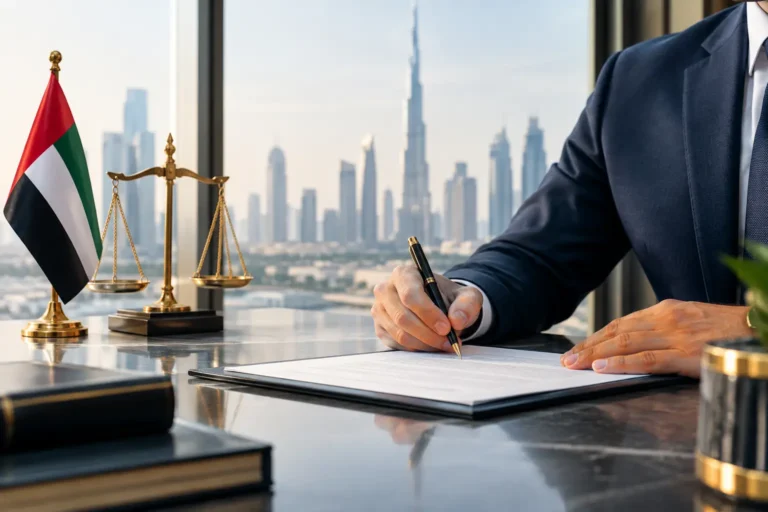
A family can be left unable to access a bank account, sell a property or make immediate arrangements for children simply because no valid will is in place. Inheritance UAE without will and succession law UAE are not issues to leave until later: the legal position can affect assets, family arrangements and day-to-day finances at a difficult time.
For expatriates in particular, assumptions based on the law of their home country can be costly. A spouse does not automatically receive complete control of the estate, jointly held assets may still require formal estate procedures, and a bank may restrict access to accounts after being notified of a death. The right route depends on the deceased’s religion, nationality, residence status, family circumstances, assets and whether a recognised will exists.
What happens when someone dies without a will in the UAE?
Dying without a valid will is known as dying intestate. The estate does not simply pass to the closest relative after a death certificate is issued. Before assets can be transferred or released, the relevant UAE court process normally identifies the legal heirs, appoints an estate representative where necessary, and determines how the estate should be distributed.
The estate can include UAE bank accounts, investments, vehicles, shares in a company, personal possessions and property. Liabilities also matter. Outstanding loans, credit facilities, rent, taxes or other debts may need to be addressed from the estate before beneficiaries receive their entitlement.
Practical restrictions can arise quickly. Banks may freeze individual accounts and, in some cases, linked or joint arrangements while inheritance formalities are resolved. A property cannot usually be sold merely because the surviving spouse or adult child wishes to do so. If the deceased held a business interest, the effect on company management and signing authority needs prompt review.
These procedures are designed to protect the estate and all potential heirs. They can, however, create delay when documents are missing, relatives are abroad, names are recorded differently across documents, or papers need certified legal translation.
Succession law UAE: the rules are not one-size-fits-all
The UAE has developed clearer civil personal-status options for non-Muslims, but succession remains a fact-specific area. The applicable legal framework can differ for Muslims and non-Muslims, and the route may also depend on the emirate and court or registration channel involved.
For Muslim estates, Sharia-based inheritance principles generally apply. Fixed shares for specified heirs are central to this framework. A surviving spouse, children, parents and other qualifying relatives may each have prescribed rights depending on who survives the deceased. This means a person cannot assume that a will can freely redirect the entire estate away from legal heirs.
For non-Muslims, UAE civil personal-status provisions can provide a different basis for inheritance where the conditions of the law are met. In broad terms, these provisions offer a civil distribution framework and have made estate planning more accessible for expatriate families. Yet they should not be treated as a substitute for a will. The precise outcome still depends on the applicable law, the composition of the family, the location and nature of assets, and the documents accepted by the authority handling the estate.
A non-Muslim’s foreign will may be relevant, but it is not automatically a practical answer for UAE assets. It may require legalisation, translation, probate recognition or further court steps. It may also fail to deal clearly with UAE property, local bank accounts or guardianship wishes. A UAE-focused will is often the more direct way to state intentions in a format designed for local execution.
Why a surviving spouse may face unexpected complications
Many people assume that marriage alone gives the surviving spouse full authority over every asset. That is not how inheritance works. Ownership and inheritance are separate questions. If an asset was legally owned solely by the deceased, it forms part of the estate and is handled through the applicable succession process.
Joint ownership can improve clarity in some circumstances, but it is not a universal solution. The ownership documents, the form of account or property registration, and the rules governing the asset all require review. It should never be assumed that a joint bank account or jointly owned home bypasses estate formalities entirely.
This is particularly significant for families relying on one person’s salary or savings. Frozen funds can affect rent, school fees, mortgage payments and ordinary household expenses. Sensible planning looks beyond the eventual division of wealth and considers whether the family can manage the first weeks and months after a death.
Guardianship is often the most urgent question
For parents of minor children, a will is about far more than money. It is the place to record clear guardianship wishes if both parents die or if the surviving parent cannot act. Without suitable instructions, decisions regarding a child may be subject to legal procedures that do not reflect the parents’ preferred arrangements.
A guardianship clause should be drafted carefully. The proposed guardian needs to be willing and suitable, and the wording should fit the family’s circumstances. International families should also consider the practical position of a guardian who lives outside the UAE, the children’s nationality, travel requirements and the location of extended family.
A will does not remove every legal safeguard. The competent authority retains its role in protecting a child’s welfare. It does, however, give the court a clear, formal record of the parents’ considered choice rather than leaving loved ones to explain informal conversations or unsigned notes.
The assets that people commonly overlook
Estate planning is often started because of a Dubai property, but the property is only part of the picture. An effective will should be aligned with the full asset position and any liabilities. This includes company shares, outstanding receivables, digital accounts, vehicles, jewellery, insurance benefits and personal effects with financial or family value.
Business owners should take particular care. A succession issue can interrupt a company’s operations at the worst possible moment. Company constitutional documents, bank mandates, signing powers and shareholder arrangements should be checked alongside the will. A personal will alone may not solve every corporate governance issue, but failing to address the estate position can leave colleagues and family facing avoidable uncertainty.
It is also wise to identify assets held outside the UAE. A separate foreign will, a UAE will, or carefully coordinated documents may be appropriate depending on the jurisdictions involved. The key point is consistency. Two documents that accidentally revoke each other or give conflicting instructions can create the very dispute they were meant to prevent.
Choosing a suitable UAE will route
Non-Muslims may have different will-registration options, including DIFC Wills Service Centre, Dubai Courts and Abu Dhabi Judicial Department channels, depending on their circumstances and the assets involved. Each route has its own eligibility requirements, scope, appointment process and documentation standards.
The best choice is not always the most familiar name or the lowest initial fee. It depends on factors such as where assets are situated, whether there are minor children, whether the will covers a single person or a couple, and whether the client is signing from the UAE or needs a process that can be managed efficiently from abroad.
The wording must be precise. A will should identify the testator accurately, revoke earlier wills only where intended, name executors or estate representatives where appropriate, identify beneficiaries clearly and deal with residual assets. It should also be signed and registered through the correct formal process. An informal template, a note on a mobile phone or a foreign document that has not been reviewed for UAE use may leave significant gaps.
Prepare before an urgent event forces the issue
A useful starting point is a confidential review of who owns what, who depends on them and what they want to happen. Gather passport and Emirates ID details, title deeds or property information, company documents, marriage and birth certificates, asset records and details of any existing wills. Where documents are issued abroad, legal translation and attestation requirements should be considered early rather than when a court deadline is already approaching.
The will should be reviewed after major life changes, including marriage, divorce, a new child, a property purchase, relocation, a change in nationality or the sale of a business. Keeping executors and close family aware that a will exists, and where its registered details can be found, can also save valuable time.
POA&More can assist non-Muslim clients with clear, compliant will preparation and registration support, including DIFC, Dubai Courts and ADJD routes. The aim is straightforward: put legally valid instructions in place while you can make decisions calmly, rather than leaving your family to untangle them later.
Need Legal Help in Dubai?
Our team of legal experts is ready to assist you with Online Power of Attorney services quickly and securely.
.
Contact us now and get a Free Legal Consultation!